Wednesday, May 26, 2010

Step one: Linear Journey

Stating with something Broken....such as a Comb all twisted and bent.
Draw the object on a piece of A3 using a black pen and the blind contour method. Take no more than 7 minutes.


Next, draw it as a continuous line drawing never taking your pen off the page. Take 7 minutes to complete.


Set up a second broken object, near to the first on a coloured square of paper. Go on to draw the second object, on the same page, beginning from the point at which you finished the first. once gain use the continuous line method and take no longer than 7 minutes to finish.


Next find nine objects which contain different examples of line; physical or graphic.
Draw each as faithfully as possible, using colour as well as the same black pen. Spend one and a half hours on this part of the exercise.


Staring on a fresh page.
Take elements and inspiration from the previous drawings, continue on to draw and/or paint a new object. Let the new object appear naturally without attempting to take too much control over the outcome.


Continue on to Step Two.

Multiplicity

The models below are a quick exploration of the possibilities and limitations of plastic chopsticks. How they responded to being cut, broken, carved, glued, scratched and bent.
The nature of the material is one of identical repetitive form and shade of colour. This lends itself to a design based on the strengths of the material. The shape of each chopstick made it ideal for stacking, layering and creating frames and repetitive forms.


Informed by the models, pictured above, the three variant designs for a necklace featured below respond to the themes of the multiple and repetition and to a need for wearability. They are designed to be made from the same plastic chopsticks as the models, once again playing to the strengths of the material.


The process of making will be very similar to the making of the moquettes too, involving, mainly glue as the method of joining. This will be coupled with silver or stainless steel links to provide movement and allow the necklace to mould to the wearer's body.


Strange Fruit

Using the Cohesive fragment collage drawings as inspiration, we created a 3D Object, once again using materials found in office supply shops.


The object is a fruit. Real or imaginary. They are worn as brooches.


This example hangs off the wearer, through a button hole, off the collar of a shirt.


The shadows cast by this piece are an integral part of the brooch, bringing an ephemeral quality to it. Also as the shadows move in conjunction with the changes in light source, they impart a sense of the time elapsed during the ripening period of the strange fruit.


Cohesive Fragments

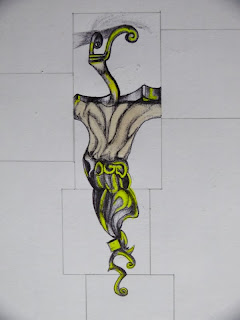
We began this drawing exercise by cutting photocopied images of historical art objects and silversmithing pieces, into 20 x 20mm squares.
These were then selected and arranged into a new configuration, combining elements of both photocopied objects. These were then glued to the page.


On a New page, we then ruled up 40 x 40mm squares in the same configuration as our chosen photocopied elements.


Next we set about recreating the elements, as faithfully as possible, as seen in the collage arrangement, further editing as we went along. We used common office materials such as ball-point-pen, masking tape and highlighters in the creation of these collage drawings.


What emerged proved to be organic, sculptural, unique and surprising images, with three dimensional elements, both actual and implied.


The images often had no clear orientation to either the vertical or horizontal.


This image depicts the drawing at the half-way point to completion. As you can see the sections are still distinct from each other, prior to the blending seen in the final cohesive collage drawing.

Friday, April 30, 2010

From Foot to Neck


All that remained of the shoe was the hard bones and gristle. The steel shank, nails, plastic sole, and tough cardboard, a single decorative button and half the clasp from the strap.
The Flower fashioned from the remaining fabric the only thing to bring any softness to the piece. Connected only with tough upholstery thread, this neckpiece came together easily and naturally.


The steel shank is supported and sewn to the contoured bed of the cardboard inner sole, no longer supporting any weight. Adorning the steel is the soft, sensuous petals of the fabric flower at its lower end. At it's top the tarnished brass button clings like a dull, cold sun.


The sole and nails hang down like the striker of a silent bell.


The black leather cord the only material brought to this piece, other than the thread which holds it all together, not taken from the shoe.
The brass hook of the clasp continues to perform it's intended function, fastening the oddly swaying conglomerate neckpiece to the wearer.


Thursday, April 29, 2010

Rebirth of an Exquisite Corpse


After the clinical dismemberment of the shoe described in the previous entry, the reassembly was begun and is now complete.
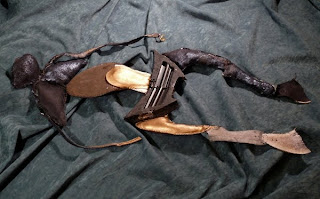
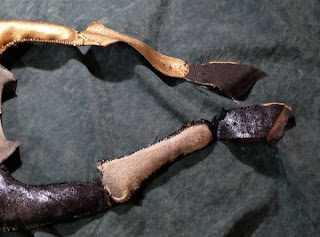
Pictured below is the second incarnation of the second hand shoe, in the form of a Worry Doll.
This outcome was in direct response to the similarities between the form of the shoe, observed during the dissection, with the body of a living being. The decision to remodel the pieces into a humanoid form was made in an effort to highlight these same similarities.


The component parts have been rearranged, reconfigured in form and shape. The order of the materials however has been largely preserved. For example; the attractive 'Skin' of the shoe remains as the exterior of the Worry Doll. This skin has been stuffed with the materials found to be underneath during the disassembly process, E.g. the various layers of lining and padding etc.


The Worry Doll can be worn around the neck. The weight of the piece is substantial enough to drag upon the wearer causing a small measure of discomfort. This conveys to the wearer something of the struggle the artist has gone through to recreate the object. The smell emanating from the Doll is an unpleasant reminder of the stresses, worries and obligations we all deal with each day.

Flower Sewn of Shoe Flesh

Pictured below is the one spare piece of cloth that was left over after creating the Worry Doll neckpiece.
The stage by stage progression of the folding, rolling and sewing of the flower is the main point of interest, the evolution or growth, rather than the object itself.
At stage 1. the fabric has no real resemblance to floral forms.
At stage 2. the bud-like form of a flower is evident.
At stage 3. the 'petals' have begun to curl and open.
At stage 4. the bud has opened in full bloom, revealing the inner texture and colour of the inside surfaces of the petals.

Stage 1 a.

Stage 2 a.

Stage 2 b.

Stage 3. a.

Stage 3 b.

Stage 4 a.

Stage 4 b.

Saturday, April 3, 2010

Slipper Ripper


Time for some more De-contruction with a mind to reassembly in new and fantastic forms.
The subject, a shoe of the femininely heeled variety. Quite the Slinky little number, this shoe had certainly seen its fair share of parties and nights out on the town.


It has to be said that the experience of dismantling this shoe was much like what I imagine an autopsy or post-mortum to be like -- predominantly sticky and foul smelling, yet strangely fascinating and insightful. Both precision cutting and brute force were required to get it into it's many constituent pieces.
Shown below are all the component parts of the Dismembered shoe. It is interesting to see how the assorted pieces of the shoe resemble the human body, remarkably so infact.
The first layer, a metallic blue fabric, was stretched over the outside of the shoe, in much the same fashion as skin. The sole of the shoe also fits into this category as the tougher skin of our own feet.
Next was a layer of tough, white-ish mesh and then a layer of sticky black elastic mesh, comparable to the fascia coating and joining the muscles in an organic body.
Next, a layer of white paper like parts and a some leather articles in roughly the same layer as the muscles.
Next was sturdy cardboard constituting the platform of the shoe this surrounded a flanged steel rod. These two components can be compared to the spinal column and the cartilage discs which cushion it, as they serve much the same function.
The hard, black plastic heel of the shoe is in its self reminiscent of the profile view of a human pelvis. It is in a comparable location too, if we take the toe as being the 'head' of the shoe's body.
The glue holding the shoe together can, with a small stretch of the imagination, be compared with blood, or what ever other sticky ichor our bodies contain.
The buckle and (purely decorative) Button can almost be looked at as jewellery worn by the shoe. The buckle is much like that which adorns a dressy, yet functional, belt and the button could be construed as an earring.


I find it fascinating that something worn on the body has much the same characteristics as the body upon which it is worn.

Come back next week to see the reincarnation of this shoe in a new form of wearable object. Beauty may not be the out-come of what has proven to be a somewhat grisly experiment, but beauty can be found in some very unlikely places.